
Common Causes of Track Failure — and How to Avoid Them
Rubber tracks are the foundation of your machine’s productivity. When they fail, everything stops — the job, the schedule, and the revenue. The good news: most track failures are entirely preventable. Here’s what causes them and what you can do about it.
1. Improper Track Tension
Track tension is one of the most common — and most overlooked — causes of premature failure. Run your tracks too loose and they’ll derail, wear unevenly on the drive lugs, or “skip” across the sprocket under load. Run them too tight and you dramatically increase stress on the track body, rollers, and idlers.
Every machine has a manufacturer-specified sag measurement for a reason. Tracks stretch naturally over time, especially in the first hours of operation on a new set. Tension should be checked regularly — not just when something looks wrong.
| How to Avoid It |
| Check tension daily or at every fuel-up in heavy-use conditions. Follow your OEM’s spec for sag (typically 1–2 inches measured mid-span). Adjust for terrain — muddy or wet conditions often require slightly looser tension to allow debris to clear. |
2. Debris Packing
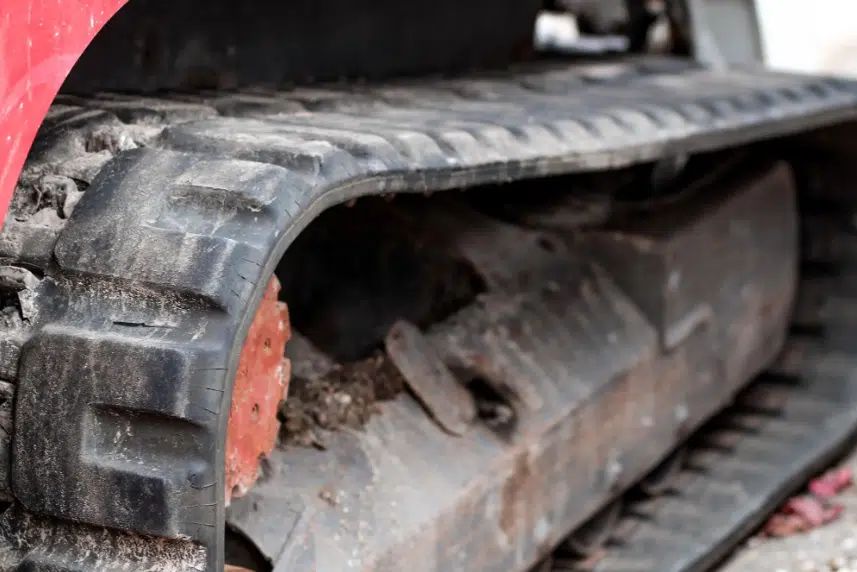
Mud, rock, concrete, and other material can pack into the undercarriage and create enormous internal pressure against the track body. This is especially common in construction, land clearing, and agricultural applications where sticky soil or gravel gets forced between the track and rollers.
Over time, packed material grinds away at the rubber, causes uneven wear on the inner surface and drive lugs, and can accelerate de-tracking — especially when the machine turns or backs up on a slope.
| How to Avoid It |
| Clean out the undercarriage at the end of every shift. Avoid prolonged spinning in place on abrasive surfaces. If you work in particularly clay-heavy or rocky terrain, inspect more frequently and consider a track pattern suited to your conditions (block patterns shed mud better; C/zig-zag patterns provide excellent traction in loose dirt). |
3. Operating on Unsuitable Surfaces
Rubber tracks are designed to handle a wide range of terrain, but they do have limits. Prolonged operation on sharp, jagged rock or concrete can cut into the rubber carcass and accelerate lug wear far beyond normal rates. Repeated sharp turns on hard pavement — particularly at high speeds — cause heat buildup and accelerated lug separation.
Continuous work on steep side slopes places uneven load across the track width and can cause the track to roll off the idler over time.
| How to Avoid It |
| Match the track pattern to your primary work surface. For predominantly concrete or hard-surface work, use a block pattern which distributes load more evenly. Minimize sharp counter-rotations on paved surfaces — use a three-point turn instead. On steep terrain, be especially attentive to track tension. |
Warning Signs Your Tracks Need Attention
- Visible cracks in the rubber
- Tracks derailing or “jumping” the sprocket
- Vibration or noise during operation
- Inner surface showing wear marks
- Missing or heavily worn drive lugs
- Uneven wear across the track width
- Track visibly sagging mid-span
- Exposed steel cords or wires
4. Worn Undercarriage Components
Your rubber tracks are only as good as the undercarriage they run on. Worn rollers, a damaged idler, or a worn sprocket will chew through a new set of tracks surprisingly fast. Sprocket wear is particularly important — a worn or hooked sprocket tooth grabs the drive lug at the wrong angle and can tear it clean off.
This is one of the most expensive mistakes operators make: installing new tracks on an undercarriage that’s already compromised. The new tracks simply absorb the damage that should have been addressed first.
| How to Avoid It |
| Before installing new tracks, inspect the full undercarriage — sprockets, rollers, idlers, and frame. Replace worn components first. At North East Attachment & Track, we carry a full line of undercarriage components to keep your machine running right from the ground up. |
5. Misalignment
Track misalignment happens when the track isn’t running centered on the rollers and idlers. This typically results from bent or damaged frame components, uneven idler wear, or a sprocket that’s out of spec. The symptom is often a track that “walks” to one side under load, causing the inner guide lugs to wear unevenly or the track edge to fray.
If left unaddressed, even mild misalignment will cause accelerated wear on the inner surface and guide lugs, and eventually track de-railing.
| How to Avoid It |
| At each tension check, visually inspect that the track is centered on the rollers. If you notice consistent one-sided wear on the inner surface, have the undercarriage frame and idler alignment inspected by a qualified technician before it compounds into a larger repair. |
6. Using the Wrong Track for the Job
Not all rubber tracks are the same, and not all track patterns are created equal. A C-pattern or zig-zag track provides excellent straight-line traction and self-cleans well in mud, but may not deliver the flotation a block pattern offers in very soft ground. Using a track designed for turf work in a demolition environment — or vice versa — shortens life dramatically and reduces machine performance.
| How to Avoid It |
| Choose your track pattern based on your primary application. North East Attachment & Track offers C, zig-zag, block, and multi-bar patterns for skid steers, compact track loaders, and mini excavators. Not sure which is right for your operation? Call us — we’ll point you in the right direction. |
The Bottom Line
The vast majority of rubber track failures come down to a handful of preventable causes: wrong tension, packed debris, worn undercarriage components, and the wrong track for the job. A few minutes of daily inspection and proper maintenance habits can easily double the life of a set of tracks — and keep your machine working when you need it most.
When it is time to replace, North East Attachment & Track carries premium-grade rubber tracks for virtually every make and model of skid steer, compact track loader, and mini excavator — with multiple tread patterns to suit your operation. We’re a US Veteran-Owned business and authorized Camso and Bridgestone dealer, shipping nationwide from Gibsonia, PA.