
Mini Excavator Attachments: 7 Tools That Transform a Small Machine
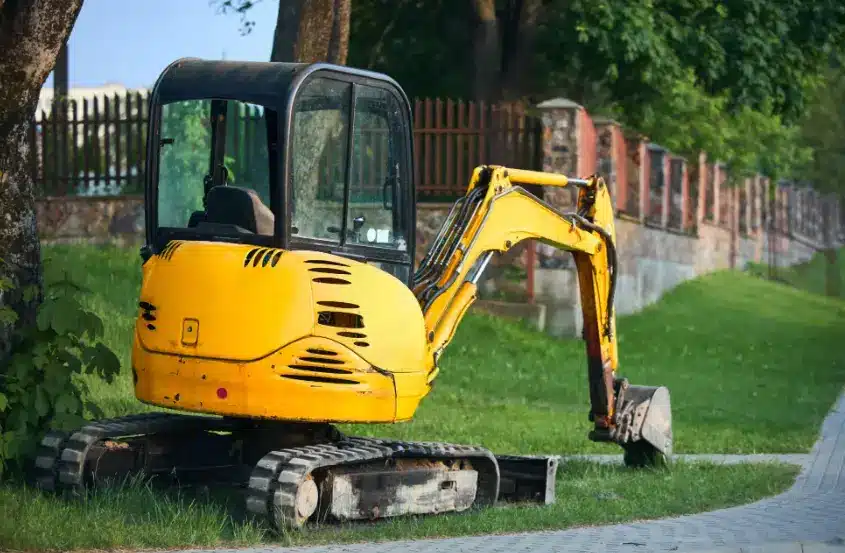
The mini excavator might be the most underrated machine in a contractor’s fleet. It’s compact enough to work in a backyard, powerful enough to dig a foundation, and versatile enough — with the right attachments — to handle a dozen different job types with a single machine.
But too many operators run a mini excavator with nothing but a standard bucket. Here are seven attachments that dramatically expand what a small machine can do, turning a digging tool into a genuine multi-purpose workhorse.
Hydraulic Breaker/Hammer
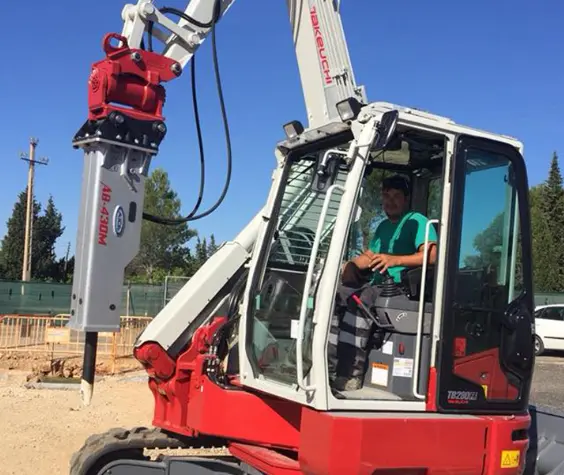
A hydraulic hammer turns a mini excavator into a precision demolition tool. Whether you’re breaking up a concrete slab, cracking through rock ledge for a trench, or busting out a footing, the breaker lets you do targeted work that a bucket can’t touch.
The key spec to match is the breaker’s service weight range to your machine class. A breaker that’s too heavy overloads the arm, puts stress on the stick pins, and compromises stability at full reach. Most mini excavators in the 2–6 ton class pair well with breakers in the 350–900 lb range — always verify with your dealer or attachment manufacturer.
- Best applications: Concrete demolition, rock breaking, utility trench work, footing removal
- Key specs: Match service weight to machine class; check carrier pressure range (bar) against your machine’s auxiliary circuit
- Pro tip: Always use a breaker-rated quick coupler if you’re swapping frequently — standard couplers aren’t designed for impact load cycles
Augers
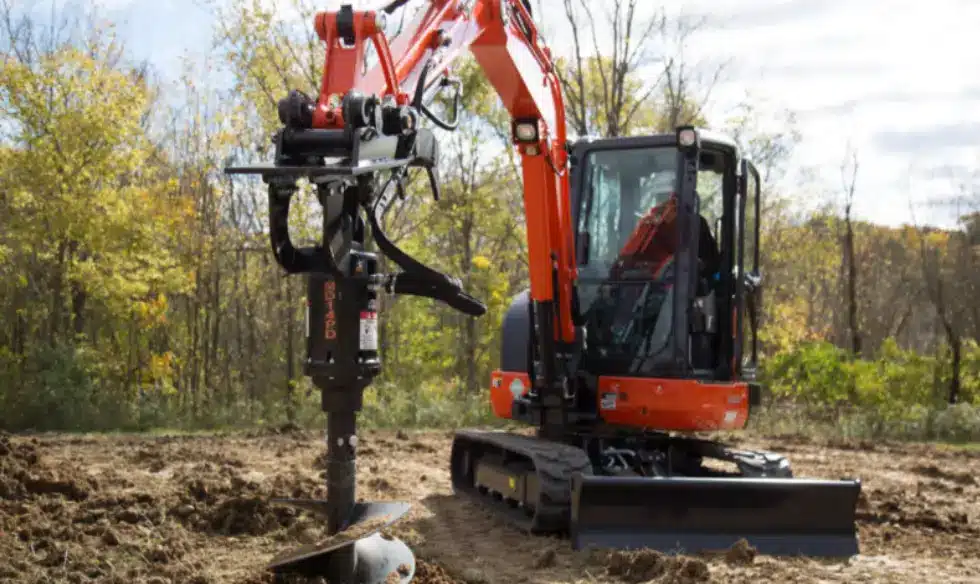
An auger attachment converts your mini excavator into a precision drilling machine. Fence posts, deck footings, helical piers for structural foundations, tree and shrub planting on landscape installs — if it involves making a clean, vertical hole, an auger is the right tool.
Matching the auger to your soil type matters as much as picking the right diameter. Clay and hard-pan soils need carbide-tipped teeth on a slower, higher-torque drive. Sandy or loamy soils work well with standard teeth and a faster drive speed. Rock requires a dedicated rock auger with extremely hard-facing tools — using a standard auger in ledge will destroy the teeth in minutes.
- Best applications: Fence lines, deck footings, sign posts, tree planting, helical pier installation, utility boring
- Diameter options: Typically 6″–36″ for mini excavator applications
- Soil matching: Standard teeth for loose/loam, carbide for clay/hard-pan, rock auger for ledge
Hydraulic Thumbs
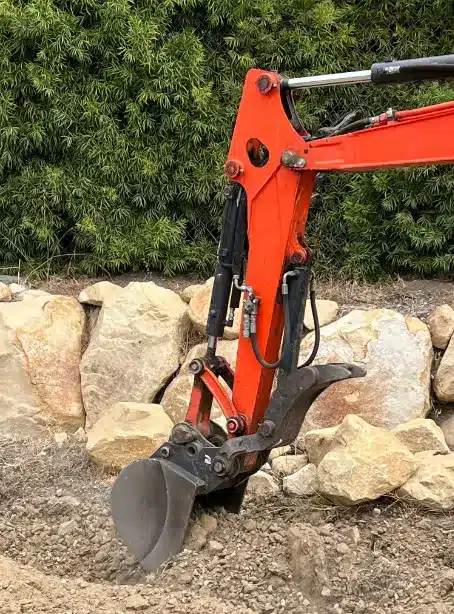
A hydraulic thumb is arguably the most cost-effective upgrade you can make to any mini excavator. It pairs with your standard bucket to create a clamping action that lets you grab, hold, rotate, and place irregular materials that a bare bucket would just push around.
Picking up a boulder, placing a stone wall block precisely, grabbing brush or demolition debris, handling logs for a land clearing job — the thumb makes all of these controlled rather than chaotic. It also dramatically reduces hand labor on sorting and cleanup tasks.
- Fixed thumb: Less expensive, locks at a set angle — good for operators who primarily work in one application
- Hydraulic thumb: Controlled from the cab, adjusts angle on the fly — significantly more versatile and worth the added cost for most operations
- Best applications: Demolition debris handling, stone and boulder placement, land clearing brush grab, log handling
Grapple Bucket
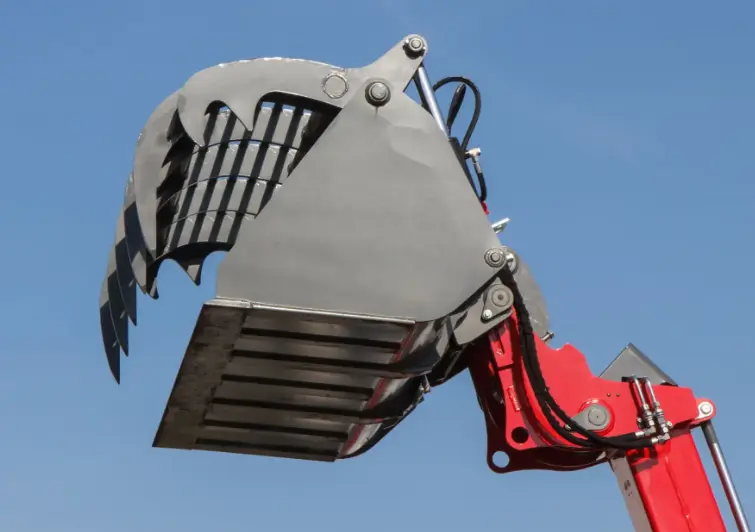
Where the thumb adds clamping ability to a standard bucket, a dedicated grapple bucket is purpose-built for bulk material handling. It opens wide, closes around a pile of brush, concrete chunks, or mixed debris, and holds it securely while you swing and drop it into a truck or dumpster.
Grapple buckets come in rotating and fixed styles. A rotating grapple lets you spin material 360 degrees from the cab, which is invaluable on demo sites where you need to sort material, orient pieces for a drop, or work in tight quarters without repositioning the machine. Fixed grapples are more economical and sufficient for straightforward cleanup work.
- Best applications: Land clearing debris, demolition cleanup, brush removal, material sorting, loading trucks
- Rotating vs. fixed: Rotating adds versatility on complex sites; fixed is cost-effective for simple pickup and drop
- Flow requirements: Rotating grapples require additional hydraulic flow for the rotation motor — confirm your machine’s aux circuit can support it
Tilt Coupler / Tiltrotator
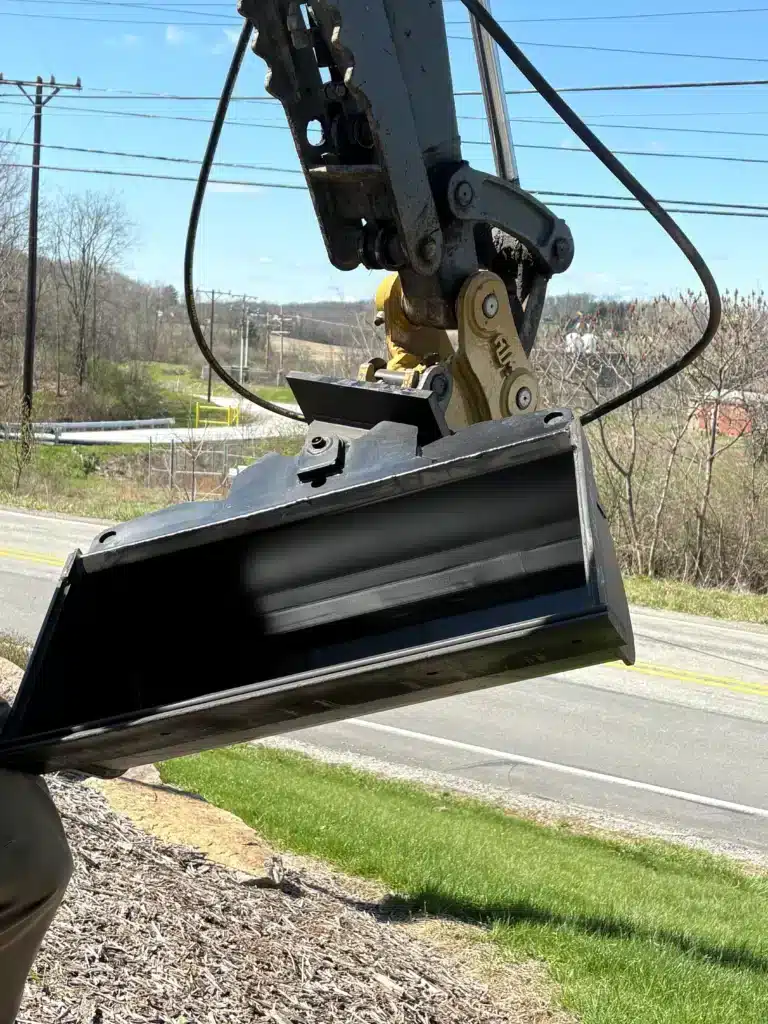
A tiltrotator is one of the most significant productivity upgrades available for a mini excavator, and it’s becoming more common on compact machines as operators discover what it unlocks. It mounts between the stick and the bucket (or any other attachment) and allows the tool to tilt side-to-side and rotate a full 360 degrees — all controlled from the cab.
The practical result is that you can follow a slope, contour a swale, cut a precise grade on a hillside, or maneuver a tool in tight spaces without repositioning the machine. What might take three or four machine moves with a fixed coupler can be done in one position with a tiltrotator. On fine grading, landscaping, and utility work, the time savings are substantial.
- Best applications: Fine grading and shaping, slope work, complex trench profiles, any precision digging or grading near structures
- Note: Tiltrotators add weight to the stick — ensure your machine’s lift capacity accommodates the unit plus the attachment
- Hydraulic requirement: Requires a third hydraulic circuit on many installations
Forestry Mulching Head
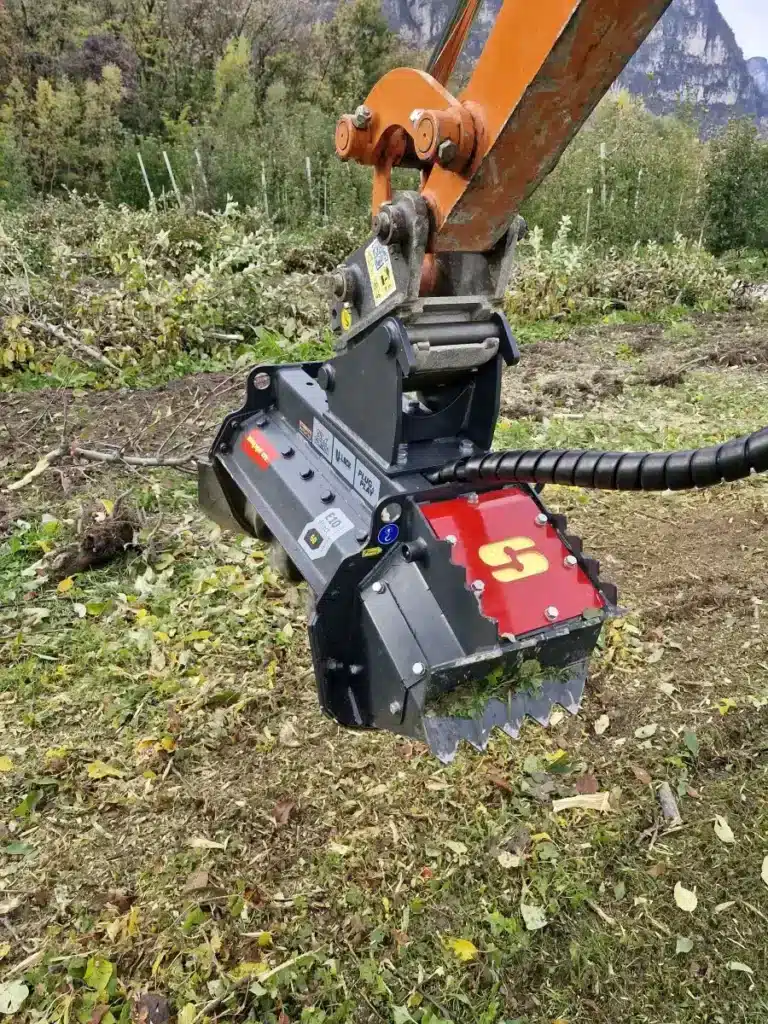
This is the attachment that makes the biggest statement about how much capability a mini excavator can carry. A hydraulic mulching head mounts to the arm and processes brush, vegetation, and trees in place — no chainsaw crews, no haul-away piles, no second pass for cleanup. The mulched material stays on site as a natural ground cover.
For lot prep, land clearing, overgrown property reclamation, roadside vegetation management, or utility right-of-way work, a compact mulcher turns what used to be a multi-day, multi-crew job into something one operator can accomplish in a fraction of the time.
We’re proud to offer the SEPPI E10 Direct, a high-performance forestry mulching head engineered specifically for mini excavators in the 2.5–6 ton class. At the heart of the unit is SEPPI’s direct-drive system, where the hydraulic gear motor mounts directly to the rotor — eliminating belts and extra wear components for higher efficiency and lower maintenance. The E10 only requires a pressure line and a return line, making integration straightforward across a wide range of excavator brands and models.
- Capacity: Processes brush, vegetation, and wood up to 4″ in diameter
- Drive system: Direct-drive hydraulic motor — no belts, minimal wear components
- Hydraulic simplicity: Integrated drainless system — only requires pressure and return lines
- Rotor tooling: Standard mini blade v-lock tools; optional mini duo tools for extended durability
- Optional rotation: 190-degree hydraulic rotation plate available for enhanced maneuverability in tight spaces
Read the full overview: SEPPI E10 Direct — Performance Overview
The Foundation Under All of It: Your Tracks
Every attachment on this list puts a different kind of demand on your mini excavator. Breakers create impact vibration. Augers create rotational torque loads. Mulchers create sustained high-hydraulic-flow operation. And through all of it, your undercarriage is what keeps the machine stable, mobile, and working.
Running worn or mismatched rubber tracks while putting your machine through attachment work is a fast path to undercarriage damage. The traction, stability, and ground pressure distribution that quality rubber tracks provide directly supports the precision and safety of everything you do from the arm.
If your mini excavator is ready for more attachment work, make sure the tracks underneath it are ready too.
Shop Mini Excavator Rubber Tracks by Machine
We carry replacement tracks for Bobcat, John Deere, Kubota, Takeuchi, Caterpillar, Case, and dozens more. Browse by your exact model to find the right fit, pattern, and spec.